Maymoune
Getting your app discovered: store optimisation and Google search
Name, keywords, screenshots, reviews, QR code: how to get your app found on the App Store, Google Play and in Google’s results.
A published app isn’t a discovered app. Millions of apps sit in the stores, and yours has to earn its place. The good news: for a local business or an association, the battle isn’t against the whole world, but against a few competitors, and above all with customers who already know you.
Store optimisation (ASO)
ASO stands for App Store Optimization: the equivalent of search engine optimisation, applied to the App Store and Google Play. Four things really matter.
The name and subtitle
The app’s name is the first search criterion. Add your trade and, if you’re local, your town: “Lison Flowers, florist in Bristol” will be found by someone typing “florist Bristol”. At Apple, the name and the subtitle are limited to 30 characters each: every word counts.
Keywords and description
Apple offers a hidden keyword field, limited to 100 characters: put in the words your customers type, separated by commas, without repeating those in the name. Google has no dedicated field: the short description (80 characters) and the full description are what count. Write them for humans, naturally using the right words.
Screenshots
They decide the install. Show your best screens, add a short line on each (“Order in two taps”, “Book your slot”) and start with the most convincing: many people only look at the first two.
Reviews
Rating and number of reviews weigh on both ranking and decision. Ask your best customers for a review at the right moment: after a successful order, not at first launch.
Google search
This is the web app’s often-forgotten strength. It has real addresses, a sitemap and clean tags: Google indexes it like a website. Your products, articles and events can appear in search results and lead straight into the app. To understand the difference with store apps, read web app or store app.
Most effective of all: your current customers
For a business, the first users won’t come from the stores. They’ll come from your premises. The channels that work best are free:
- A QR code on the counter, the window, menus, bags, receipts. See how to get your app installed.
- A sentence at the till: “Do you have our app? There’s an offer on your first order.”
- Your website, emails and social media, with a link to the app.
- A reason to install: a promo code, an exclusive offer, online booking, an always up-to-date menu.
Measure to improve
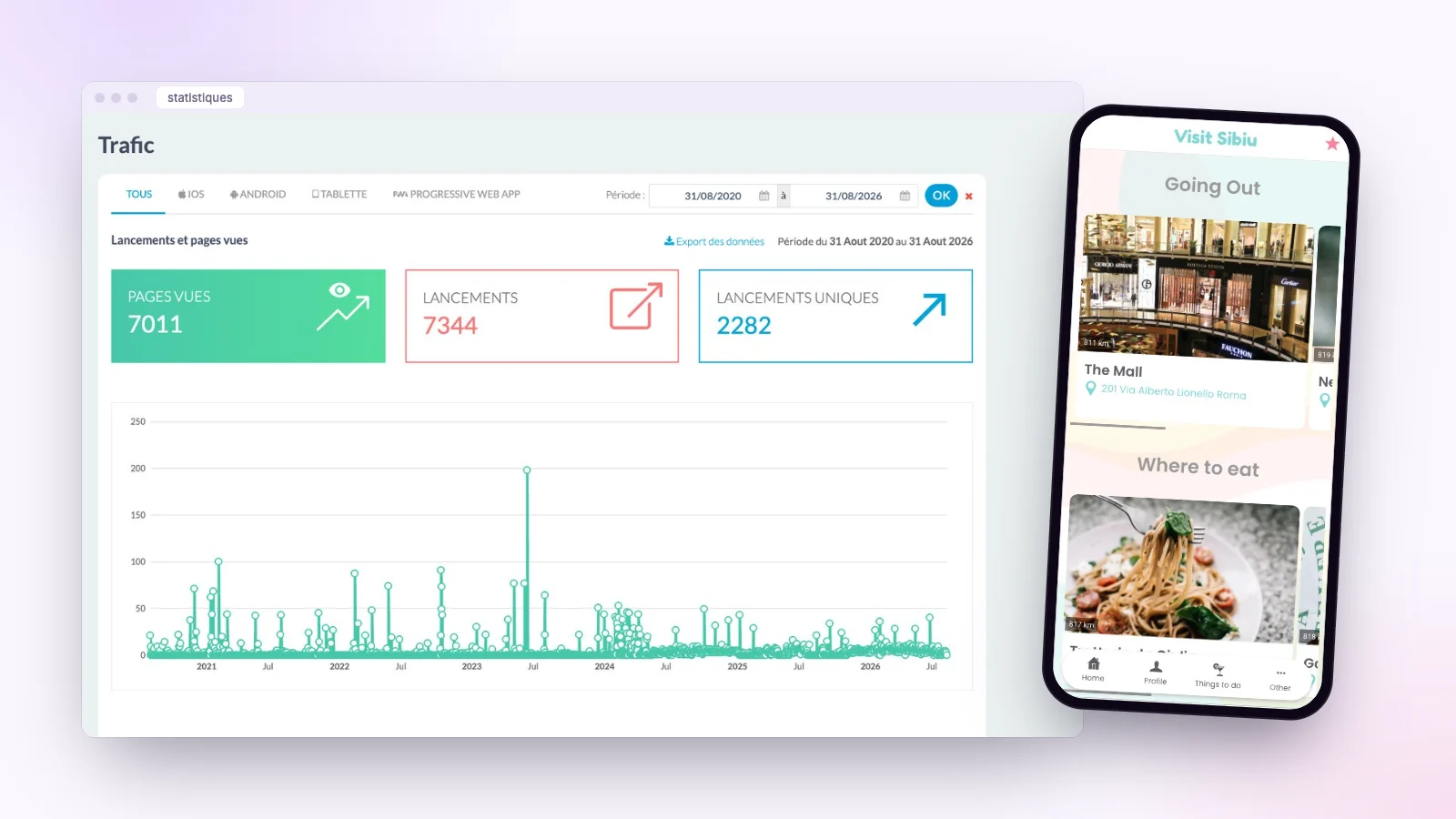
The back office shows page views, launches, downloads and the platforms used. Look at them every month: if launches rise after a notification or a poster, you know what to do again.
Mistakes that hold discovery back
- An app name that says nothing about the business.
- Empty screenshots, or screenshots of an app not yet filled.
- Announcing the app before it has content.
- Relying only on the stores, with no QR code or link at home.
Other traps are listed in the 10 launch mistakes to avoid, and publishing itself is detailed in publishing on the App Store and Google Play.
What it costs
At Maymoune, every feature is included in all three plans, detailed on the pricing page:
- Starter, €19 a month: your web app, installed from a link or a QR code.
- Ultra, €59 a month: the same, plus the iPhone, iPad and Android app on the stores.
- Ultra Lifetime, €2,999: one single payment, with publication on the App Store and Google Play included.
Maymoune Apps
An app people find, and keep
Web, iPhone and Android, visible on Google and in the stores.
✓ Web app indexed by Google
✓ Store listing prepared on request
✓ Traffic statistics included
✓ Support included
For content ideas that make people come back, see the 30 content ideas. Other questions are in the FAQ.
Frequently asked questions
What is ASO?
App Store Optimization, the equivalent of SEO for the App Store and Google Play: name, keywords, description, screenshots and reviews.
Can an app appear in Google?
Yes, the web app. It has real addresses, a sitemap and clean tags: Google indexes it like a website.
How many characters for an app name?
At Apple, 30 characters for the name and 30 for the subtitle, plus a 100-character keyword field.
How do I get my first users?
Through your current customers: a QR code in store, a sentence at the till, a link in your emails and an offer on the first order.
How much does an app cost at Maymoune?
€19 a month for the web app, €59 a month with iPhone and Android, or €2,999 once and for all. Details are on the pricing page.
Up next
 News of Maymoune
Making money with your app: 6 models that work for a business
Online sales, bookings, subscriptions, advertising, loyalty: the models that make an app genuinely profitable, and which one to choose for your business.
4 min read18 Oct 2026 News of Maymoune
Agency, freelancer or no-code tool: how to choose to build your app
Price, timelines, maintenance, ownership: an honest comparison between an agency, a freelance developer and a no-code tool for building a mobile app.
4 min read17 Oct 2026 News of Maymoune
How long does it take to build a mobile app? The real timeline
One day for the web app, a few weeks for the stores, several months with an agency: the real timeline for building…
4 min read17 Oct 2026