Maymoune
Creating an app for free: what’s really free, and what never is
Free builders, store accounts, hosting, updates: what’s really free when you create a mobile app, and what always ends up costing something.
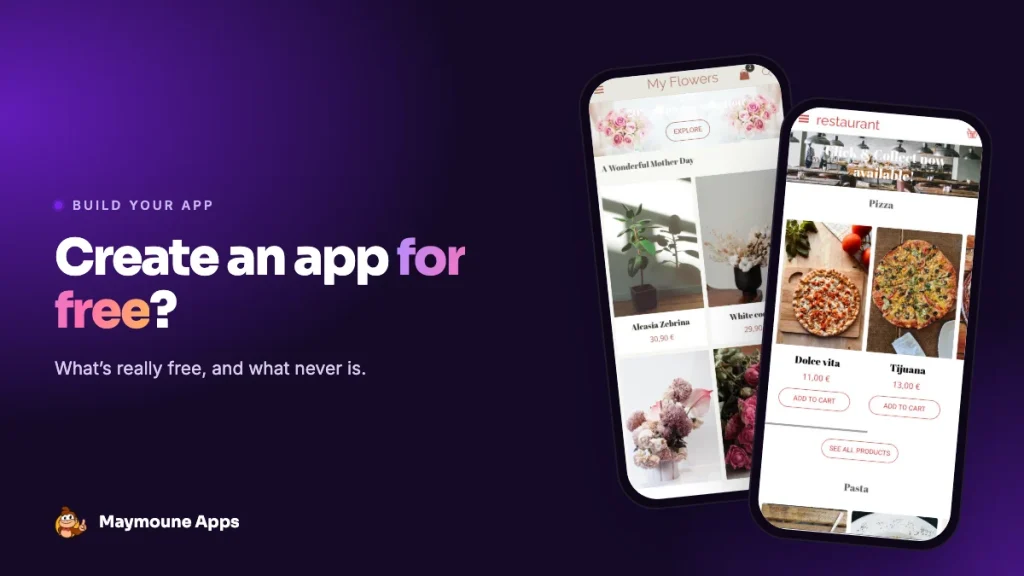
“Create an app for free” is one of the most searched phrases among shop owners and associations. The honest answer fits in one sentence: you can start without paying, but an app that’s alive, on the stores and under your own name always ends up costing something. Here’s what, and how much.
What “free” offers really mean
When an app builder says “free”, it’s almost always one of these three:
- A trial period: you build freely, but the app can’t be published until you switch to a paid plan.
- A limited version: the app is online, but with the builder’s name on it, an address like your-name.builder.com, a page limit or ads you don’t control.
- A commission model: the builder charges nothing, but takes a percentage of every sale made in the app.
None of these is dishonest. You just need to know which one you’re looking at, because the real price shows up the day the app starts being useful.
What’s never free
Apple and Google developer accounts
To appear on the App Store and Google Play, an app must be published under its owner’s accounts. Apple charges $99 a year, Google $25 once. Those prices are set by them, and no tool can remove them. If a “free” offer promises you the stores, it publishes the app under its own account: then it isn’t really yours.
Hosting and updates
An app means servers running day and night, notifications being sent, images being stored. And every year, Apple and Google release new versions of iOS and Android: an app that isn’t updated ends up displaying badly, then gets removed from the stores. Someone pays for that work. If it isn’t you, it’s advertising or a commission.
Your time
This is the most forgotten cost. A free but complicated tool can cost you whole evenings. A paid but simple tool gives those evenings back. Count your time as an expense, and the comparison often flips.
What can really be free
There is good news, though. Several things cost nothing, whatever the tool:
- The web app (also called a PWA): it installs on the home screen from a link or a QR code, without going through the stores, so without a developer account. It’s all explained in our guide web app or store app.
- Notifications: once the app is installed, reaching your customers costs nothing more, unlike text messages.
- Word of mouth: a QR code on the counter, a menu or a poster gets the app installed without spending a cent on ads. See how to get your app installed.
The right sum: what an app costs over a year
Rather than “free or paid”, ask yourself one question: how much will this app cost me over twelve months, all in? Add up the subscription, the store accounts, the commissions on your sales, and the time spent.
An app at €19 a month with no commission comes to €228 a year. A “free” app that takes 2% of €20,000 in sales costs you €400 a year, and the figure grows with your success. We’ve detailed every item in our article on the price of a mobile app.
How to spend as little as possible
- Start with the web app. It’s online the same day, with no developer account and no review to wait for.
- Really fill it. An empty app is useless, free or not. Our 30 content ideas will keep you going for months.
- Get it installed with a QR code and a link in your emails.
- Move to the stores when your customers ask. The day you want to be on the App Store and Google Play, it’s the same app with the same content: nothing to redo.
What it costs at Maymoune
Maymoune has no free plan, and that’s a choice: no ads in your app, no commission on your sales, and the Maymoune name appears nowhere, neither in the app nor on the stores. Plans have no commitment and can be cancelled in one click.
At Maymoune, every feature is included in all three plans, detailed on the pricing page:
- Starter, €19 a month: your web app, installed from a link or a QR code.
- Ultra, €59 a month: the same, plus the iPhone, iPad and Android app on the stores.
- Ultra Lifetime, €2,999: one single payment, with publication on the App Store and Google Play included.
Maymoune Apps
An app under your name, commission-free
Three plans with no commitment, every feature included.
✓ Web app online the same day
✓ No commission on your sales
✓ Your name, not ours
✓ Support included
Before you decide, open the example apps on your phone, or read the FAQ. To see what it looks like for your business, the guide by trade covers dozens of trades.
Frequently asked questions
Can you create a mobile app for free?
You can start without paying, with a trial or a limited version. But an app published on the stores, under your name and without ads, always has a cost: at the very least Apple’s and Google’s developer accounts.
How much do developer accounts cost?
$99 a year at Apple and $25 once at Google. These prices are set by Apple and Google, not by the tool you use.
Is a web app free to publish?
Yes. It doesn’t go through the stores: it installs from a link or a QR code, without a developer account. You still pay the subscription of the tool that hosts it.
Does Maymoune take a commission on sales?
No, none. What you sell in your app is entirely yours, whatever your revenue.
What’s the cheapest plan?
Starter, at €19 a month with no commitment, for the web app. Details are on the pricing page.
Up next
 News of Maymoune
Getting your app discovered: store optimisation and Google search
Name, keywords, screenshots, reviews, QR code: how to get your app found on the App Store, Google Play and in Google’s results.
3 min read18 Oct 2026 News of Maymoune
Making money with your app: 6 models that work for a business
Online sales, bookings, subscriptions, advertising, loyalty: the models that make an app genuinely profitable, and which one to choose for your business.
4 min read18 Oct 2026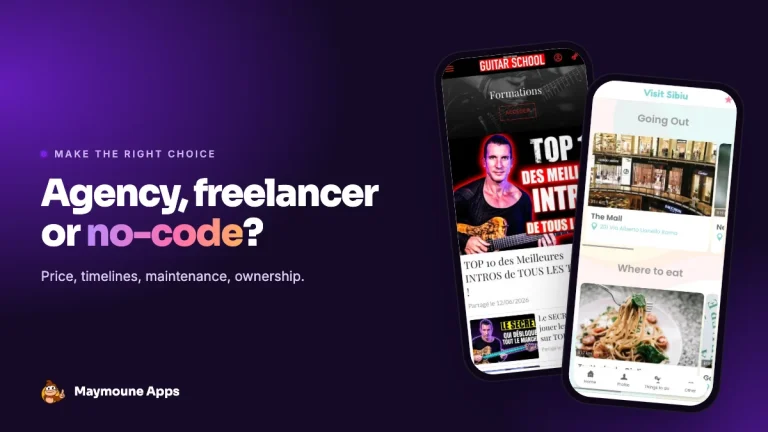 News of Maymoune
Agency, freelancer or no-code tool: how to choose to build your app
Price, timelines, maintenance, ownership: an honest comparison between an agency, a freelance developer and a no-code tool for building a mobile app.
4 min read17 Oct 2026