Maymoune
Restaurant mobile app: what it really changes
A mobile booking app for a restaurant isn’t just for show. It helps you take back direct orders with zero commission, and fill a slow shift with a notification sent at 4:00 PM. Here is what it practically…
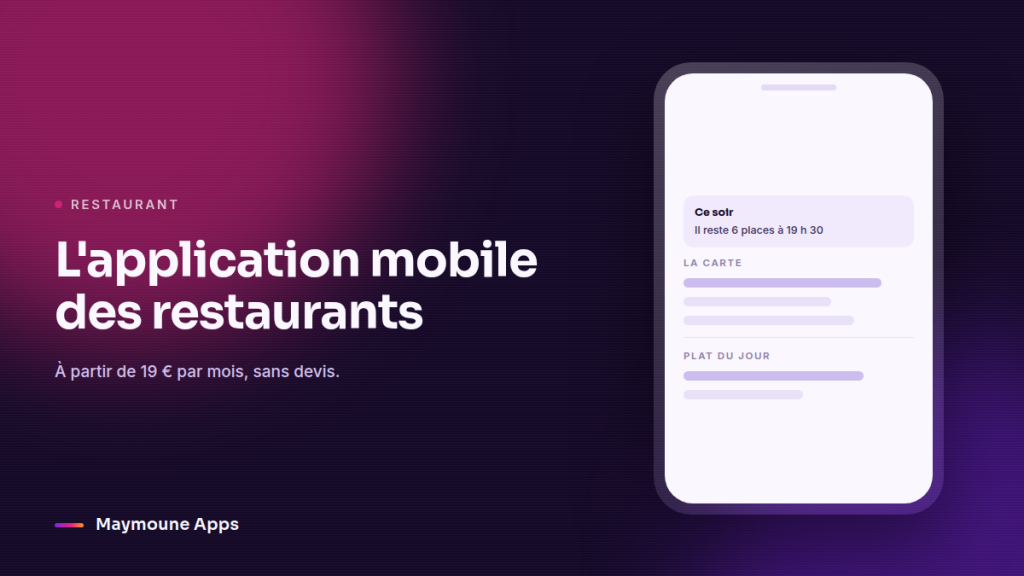
A mobile booking app for a restaurant isn’t just for show. It helps you take back direct orders with zero commission, and fill a slow shift with a notification sent at 4:00 PM. Here is what it practically changes, the screens that matter, the pricing, and what it won’t do for you.
Tuesday evening, 7:00 PM. Twelve covers booked, forty seats. You already know the dining room won’t fill up. You have three hundred customers who came at least once this year, and no way to let them know tonight that you still have tables available.
You can post on social media : a few dozen people will see the message, chosen by an algorithm that doesn’t know your dining room. You can pay to be seen. Or you can press a button and land directly on the screens of people who have already eaten at your restaurant.
Table of Contents
What platform dependency costs
Delivery and booking platforms do real work : they bring customers you wouldn’t have had. It’s not a scam, it’s a service, and it comes at a cost.
The problem isn’t the commission. The problem is what you don’t get in return : the customer remains theirs. You don’t know their name, email address, or how often they visit. The day you want to reach them, you have to go through the platform again — and pay again.
A restaurant that has been running for five years has served thousands of people. If these people are not in a database that belongs to you, your most valuable business asset is rented out to someone else.
What an app changes in your week
Notifications replace posters. A quiet shift, a new product delivery, a daily special you love : you write two lines and they land on your customers’ home screen. No algorithm between you and them, no advertising budget.
The menu stops being inaccurate. A changing menu, a daily board, an unavailable dish : you update it from your phone in two minutes, and it’s up to date everywhere. No more 2024 PDF lingering on three different websites.
Orders come directly to you. Click and collect, takeaway, reservations : your customer uses your app, not a marketplace. What they pay goes to you.
Loyal customers are recognized. Loyalty cards, exclusive offers for regulars, event invitations : you know who comes back, and you can reward them.
The screens that matter for a restaurant
A restaurant app doesn’t need twenty sections. Five are enough, and they are always the same :
- The menu — with photos, allergens, prices, and updates right from your phone.
- Book or order — one button, not a three-screen form.
- Daily special — the section that gives a reason to open the app every week.
- Find us — opening hours, directions, phone number, closing days.
- Loyalty — the digital stamp card that doesn’t get lost at the bottom of a wallet.
Everything else is optional and can be added later, once you know what your customers actually open.
Restaurants already have theirs built on this model : Agounate and Charlie are among those whose apps you can open today.
What we connect, what we create
Your app’s content comes from three sources, and all three work together.
- What you already have — your website, your online store, your social networks, your reservation schedule. We connect them, nothing needs to be re-entered.
- What you create in the back office — the menu, photos, news, details for each dish. You do it yourself, from your phone or computer.
- What AI writes for you — dish descriptions, translations for international customers, notification copy. You review, you publish.
Everything is managed from a single dashboard, without going through a third-party provider.
How much does it cost
No quotes, no mandatory appointment to find out the price. Three plans, the same app, one difference : where it is installed.
- €19 per month — your PWA web app. Your customers add it to their home screen via a QR code placed on the table. It is the format that suits most restaurants.
- €59 per month — the same, plus the iPhone and Android apps published on the App Store and Google Play.
- €1,999 one-time — the complete plan, for life, with no subscription.
To be compared with the budget of a custom-developed application : in France, the median for an agency project is €30,000, and based on the quotes I’ve seen, it’s more of a floor than a ceiling. I detailed the differences in the article on the cost of a mobile app. View the three plans.
What an app won’t do
It won’t bring you customers you don’t already have. An app fills up with people who already walk through your door, already read your messages, or scan the QR code on their table. It is not an acquisition channel, it is a customer loyalty channel. If your dining room is empty because nobody knows you, start somewhere else.
Nor does it replace your POS software, and it doesn’t organize delivery for you : drivers, delivery routes, zones—that remains your job or that of a partner.
Finally, an app that is never updated dies in three months. Allow for ten minutes a week. If no one on your team can take those ten minutes, the app will be useless, regardless of its price.
Next step
Open an existing restaurant app on your phone, and look at it as if you were your own customer : is the menu easy to read, is the booking button where you look for it, does the loyalty program make you want to come back. It takes three minutes, and it’s worth every argument.
Frequently Asked Questions
How much does a mobile app for a restaurant cost ?
At Maymoune : €19 per month for the web app installable via a QR code, €59 per month with iPhone and Android apps published on the app stores, or a one-time fee of €1,999 for the full lifetime plan. Custom development handled by an agency averages around a median of €30,000.
Do my customers have to download anything ?
With the €19 plan, no : they scan a QR code placed on the table and add the app to their home screen in two simple steps. With the €59 plan, they can also download it from the App Store or Google Play, just like any other app.
Can I update my menu myself ?
Yes, that’s actually the main point. The menu, photos, prices, daily specials, and opening hours can all be edited from your app’s back office on a phone or computer, and updates are visible immediately.
Does it replace delivery platforms ?
Not completely. Platforms bring you customers who don’t know you yet; your app serves to retain those you already have and get them to order directly. Many restaurants keep both, gradually shifting their regulars over to the app.
How long does it take to set up ?
The web app is available immediately after ordering: you receive its link and fill it in. The actual time depends on what you spend on your content — menu, photos, text. For app stores, the turnaround depends on Apple and Google review.
Do you need to know how to use a computer ?
You just need to know how to write a message and add a photo. The back office is built for this, documentation is available in 16 languages, an in-app assistant answers questions, and human support takes over if you get stuck.
What if I have multiple locations ?
Two approaches: a single app with a section per location, or one app per location if the menus and audiences are truly different. The choice mainly depends on how you are organized; this is the kind of case we look at together before purchasing.
Up next
 News of Maymoune
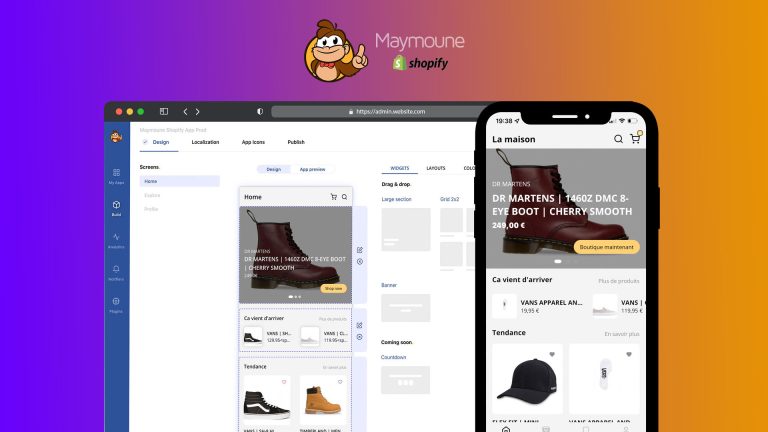
 Create an iPhone and Android app for your Shopify store
Your customers arrive at your Shopify store from their phone, look at two products, and close the tab. A mobile app changes…
3 min read16 Sep 2026 News of Maymoune
 Mobile app for a store: sell commission-free
A marketplace brings you customers and keeps the relationship. An app gives you both back. Catalog connected to your existing store, direct…
6 min read16 Sep 2026 News of Maymoune
 Mobile app for a gym or sports club
A club thrives on communication. Schedules, slot bookings, call-ups, results, membership fee reminders: an app puts all of this directly on members’…
6 min read16 Sep 2026