Maymoune
How much does a mobile app for a business cost in 2026?
In France, the median cost of a mobile app project entrusted to an agency is €30,000. A business almost never needs that. This article compares the three ways to pay for an app — agency, freelance developer, subscription…
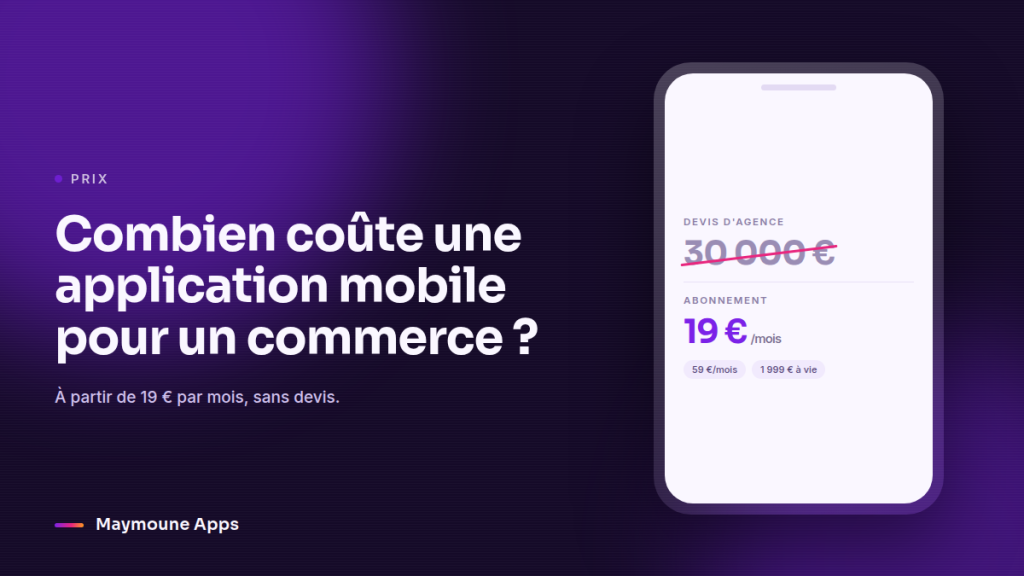
In France, the median cost of a mobile app project entrusted to an agency is €30,000. A business almost never needs that. This article compares the three ways to pay for an app — agency, freelance developer, subscription — and details the costs that quotes never show.
You request three quotes for your business’s app. The first comes back at 18 000 €. The second at 42 000 €. The third never replies. Nobody explains the gap to you, and nobody tells you what happens the following year. You close the file, and the idea stays in the back of your mind for two years.
This is not a budget issue. It is a problem with the question. “How much does an app cost?” has no answer, any more than “how much does a vehicle cost?”. The real question is: what app do I need, and what does that one cost?
Table of Contents
What a custom app really costs
The figures are out there. La Fabrique du Net analyzed 216 real mobile development projects, with data up to June 2026. Here is what it looks like:
- Median: €30,000 — half of the projects cost less, the other half more.
- Core market: €15,000 to €50,000 — where half of the quotes fall.
- Entry-level: €7,000 — the lowest 10%.
- 31% of projects exceed €50,000.
My industry experience tells me that these figures are even below reality. The quotes clients showed me before coming to me were rarely lower: they almost always add an annual maintenance line, a deployment line, and an amendment for the first upgrade.
These amounts are not unjustified. An application developed from a blank slate means specifications, mockups, two different codebases for iPhone and Android, testing, deployment, and a team spending months on it. The price is consistent with the work.
The question is therefore not whether the quote is fair. It is whether your business needs development from scratch. In the vast majority of cases, it does not.
The three ways to pay for an app
1. The agency. You pay for a project. You get an app that exists nowhere else, and a single point of contact who takes responsibility for the result. On the other hand : a five-figure budget, a three-to-nine-month turnaround, and an annual maintenance bill. The day you want to change a button color, you reopen a ticket.
2. The freelance developer. Cheaper, often two to four times less. You work directly with the person who codes, which is a real comfort. The risk lies elsewhere : if they change careers, take a long leave of absence, or stop answering, your app no longer has a doctor. Many business owners found this out during an iOS update.
3. The subscription. You don’t pay for custom development, you pay for the use of technology that is already built, already tested on thousands of apps, and already maintained. You build your app from existing building blocks, fill it with your content, and publish it. The price is known in advance and doesn’t change.
These three paths do not serve the same need. The third covers what a restaurant, a shop, a club, or a training organization needs in 90 % of cases : content, a catalog, a calendar, notifications, a shop, a profile, a map.
The costs the quote doesn’t show
Whichever path you choose, four recurring costs always come up, and they are rarely in the initial quote.
- Developer accounts — $99 per year with Apple, a one-time fee of $25 with Google. These are your accounts, in your name: you own the published app, and that is exactly how it should be.
- System updates — Apple and Google update their rules every year. A custom app must keep up, and someone has to be paid for that.
- Content modifications — changing a photo, a menu, a price. If you cannot do it yourself, every change has to go through a service provider.
- Publishing time — creating store listings, screenshots, copy, and the back-and-forth with the app stores. This is the item that everyone underestimates.
The third point is the one that costs the most over three years. An app that you cannot update yourself becomes an app that you no longer update. And an app that never changes, nobody keeps on their phone.
What a business really needs
Before comparing prices, make a list of what the app needs to do. For a business, it almost always comes down to six points :
- An icon on the home screen — being there, every day, without paying for advertising to be seen.
- Notifications — announcing something new, filling a slow slot, giving notice of a closure.
- The catalog or menu — up to date, editable in two minutes from your phone.
- Sales or bookings — directly, with no marketplace commission.
- Loyalty — recognizing a returning customer.
- Your content — photos, news, videos, without reposting them across five platforms.
None of these six lines requires custom development. They already exist, they are proven, and they can be managed from a dashboard. That is exactly what the subscription model is all about.
Pricing at Maymoune, transparently displayed
At Maymoune, there are no quotes. Three plans, the same service, one difference : where your app is installed.
- €19 per month — your PWA web app. It installs on the home screen from a link, without going through an app store, on both iPhone and Android.
- €59 per month — the same, plus the iPhone app and Android app published on the App Store and Google Play.
- €1,999 one-time — the complete package, for life, with no subscription.
In all three cases, the following are included: updates, notifications, the integrated shop, content and media, your domain name, and white label — your name, your icon, your colors, Maymoune appears nowhere. Human support answers your questions, and the documentation lives inside your application’s back office.
Compare over three years, that’s where the difference shows: €684 for the web app, €2,124 for the app published on both stores. Compared to a median of €30,000. See the details of the three plans.
When custom-built remains the right answer
I’m not going to tell you that a subscription replaces everything. There are cases where it’s not enough, and it’s better to know before paying.
If your application needs to control hardware, integrate deeply with niche business software, process a very specific data stream, or feature a mechanism that no one has built yet — then custom development is the right answer, and an agency quote is justified. This is also the case if your application is your product, and not just a tool for your business.
Between the two, there is a gray area: a standard application, but with two or three specific needs. These cases are handled on a case-by-case basis on the Services page.
Next step
The easiest thing to do before comparing anything is to see what live apps look like : a shop, a restaurant, a club, a training organization. In two minutes, you will see if your needs are covered, and you will have an honest basis for comparison when reviewing your next quote.
Frequently Asked Questions
How much does a mobile app cost in 2026 ?
For custom development entrusted to a French agency, the median is €30,000, and the core of the market ranges between €15,000 and €50,000 (La Fabrique du Net, 216 projects, June 2026). For an app built using existing technology, it is based on a subscription : at Maymoune, €19 per month for the web app, €59 per month with published iPhone and Android apps.
Why is there such a difference between two app quotes ?
Because the word “app” says nothing about the work involved. A catalog with notifications and a marketplace with payments, geolocation, and messaging do not require the same number of days. Before comparing, write down the list of what the app needs to do : the difference between quotes is almost always explained by this list.
Do you have to pay Apple and Google extra ?
Yes, if you publish on the app stores : $99 per year for the Apple developer account, a one-time fee of $25 for Google Play. These accounts are in your name, so the published app belongs to you. The PWA web app does not go through any store and therefore incurs none of these fees.
An app for €19 per month, what’s the catch ?
There’s no catch, it simply means you’re not paying for custom development. The technology is already built and already maintained ; you rent its use and build your app on top of it, with your content, your name, and your branding. What you cannot do is ask for functionality that doesn’t exist anywhere : that requires custom development.
What happens if I cancel the subscription ?
The app stops being served, like any monthly service. Your content remains yours and your Apple and Google developer accounts stay in your name. If the idea of a subscription bothers you, the one-time €1,999 plan exists for this reason.
How long before having the app online ?
The web app is available immediately : you receive its address and you share it. For app stores, the timeline mainly depends on Apple and Google, which review each listing. Custom development, on the other hand, takes months.
Can I edit my app myself ?
Yes, that is the key point. Content, the menu, the catalog, colors, and notifications are configured from your app’s back office, without relying on anyone. Documentation is also available there, translated into 16 languages, and human support is there to answer your questions.
Up next
 News of Maymoune
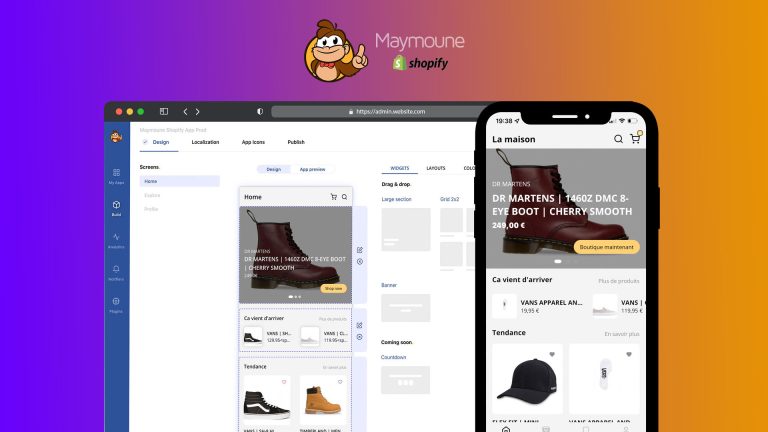
 Create an iPhone and Android app for your Shopify store
Your customers arrive at your Shopify store from their phone, look at two products, and close the tab. A mobile app changes…
3 min read16 Sep 2026 News of Maymoune
 Mobile app for a store: sell commission-free
A marketplace brings you customers and keeps the relationship. An app gives you both back. Catalog connected to your existing store, direct…
6 min read16 Sep 2026 News of Maymoune
 Mobile app for a gym or sports club
A club thrives on communication. Schedules, slot bookings, call-ups, results, membership fee reminders: an app puts all of this directly on members’…
6 min read16 Sep 2026