Maymoune
Mobile app for a store: sell commission-free
A marketplace brings you customers and keeps the relationship. An app gives you both back. Catalog connected to your existing store, direct sales without commission, notifications instead of advertising: here is what it changes for a business, at…
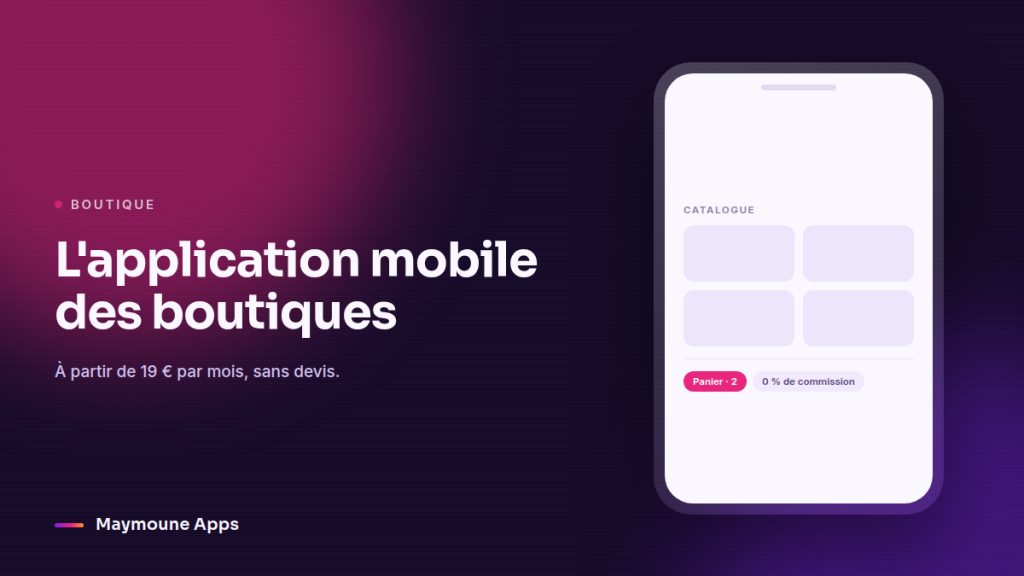
A marketplace brings you customers and keeps the relationship. An app gives you both back. Catalog connected to your existing store, direct sales without commission, notifications instead of advertising: here is what it changes for a business, at what cost, and when it becomes profitable.
You have a store. Maybe online, maybe a brick-and-mortar shop, often both. You also sell on a marketplace because the foot traffic is there. And every month, you look at the commission line, telling yourself that you will never see those customers again if you leave.
The calculation is simple to make, yet hardly anyone does it : how much does not having a direct channel to your own customers cost you each month ?
Table of Contents
The true cost of the marketplace
The commission is visible, so it is discussed. What costs the most is invisible.
The customer does not belong to you. Their email address, history, purchase frequency : all of that stays with the intermediary. You rent access to people who nonetheless bought your products.
You are competing on your own product listing. Under your product, the marketplace displays five others, cheaper. That is their business, not yours.
You pay twice for the same person. A commission upon purchase, then an advertising budget to bring them back. An app reverses this cycle : the second purchase costs nothing.
What the app changes for a store
The icon replaces SEO. An installed app means your name on the home screen, every day, next to the apps your customer already opens. You no longer have to buy that spot.
The notification replaces advertising. A restock, a new arrival, a private sale, clearance items : the message arrives directly. No bidding, no algorithm, no plummeting open rates.
The cart comes back to you. The order goes through your store, with your terms, your shipping fees, your customer relationship. What the customer pays, you collect.
In-store and online come together. In-store pickup, item reservation, shared loyalty card : the customer no longer has two relationships with you, they have one.
Connect your catalog rather than re-entering it
It’s the number one fear : “I’m not going to retype 800 items”. You won’t have to.
If your store already exists somewhere, it connects directly : products, inventory, prices, orders follow. Your app becomes a second storefront for the same inventory, not a parallel catalog you have to maintain. Details on connectable stores can be found on the e-commerce mobile app page.
If you don’t have an online store yet, the app includes one : the built-in store is included in all three plans, including the first one. You can therefore start with the app, and the website will come later — or never.
And for the product pages that no one ever had time to write, the built-in AI writes the descriptions and translates them ; you simply review and publish.
The screens that matter for a store
- The catalog — with search and categories, connected to your real-time inventory.
- The product page — photos, price, availability, and a buy button that doesn’t take six screens.
- New arrivals — the section that gives a reason to open the app every week.
- Loyalty — points, exclusive offers, early access.
- My account — orders, tracking, returns : avoiding “where is my order?” messages.
Businesses already have theirs built on this model : Charles Shop, Le Nid à Pain, or Univers Minéral are among those whose apps you can open today.
How much it costs, and when it becomes profitable
- 19 € per month — your PWA web app, installable from a link or a QR code, store included.
- 59 € per month — the same, plus the iPhone and Android apps published on the App Store and Google Play.
- 1 999 € one-time — the full package, for life, no subscription.
The profitability calculation comes down to one line : compare the monthly subscription to what you pay in commissions and advertising to bring a customer back. Many businesses reach break-even with just a few direct orders per month rather than through an intermediary.
The point of comparison on the other side : a custom-developed app by an agency, for which the French median is €30,000 — and based on the quotes I’ve seen, this figure is more of a floor — the details are in the article on the cost of a mobile app. See the three plans.
What an app will not do
It will not bring you new customers all by itself. An app is filled with people who already know you : your buyers, your database, passersby in your store, your followers. If your challenge is being discovered, an app is not the first expense to make.
Nor does it replace your POS software or your inventory management : it connects to them, it does not replace them. And if your catalog does not exist anywhere in a structured format, it will have to be built once — AI helps with writing, it does not invent your product references.
Next step
Take a store app that is already online and go through the entire journey on your phone : search for a product, open a product page, add to cart. If this journey is shorter than the one on your current site, you have your answer.
Frequently Asked Questions
How much does a mobile app for a store cost?
€19 per month for the web app with the integrated store, €59 per month with iPhone and Android apps published on the stores, or a one-time fee of €1,999 for the complete lifetime plan. No quotes, no commission on your sales.
Do I have to re-enter my entire catalog?
No. If your online store already exists, it connects directly: products, prices, stock, and orders follow, and your app becomes a second storefront for the same inventory. If you don’t have an online store yet, the app’s built-in store is enough to get started.
Is there a commission on my sales?
No. You pay the subscription, not a percentage of your revenue. The remaining fees are those of your payment provider, just like on your website.
Is an app useful for a local business?
Often more than for an online-only store, because you see your customers in person: a QR code at the checkout is enough to get the app installed. After that, a notification replaces the flyer, and loyalty cards never get lost.
Can my app keep the same inventory as my store ?
Yes, that is the whole point of the integration : one single inventory, a single source of truth. You avoid the classic issue of an item being sold twice because two catalogs were operating separately.
How many customers does it take to make it worthwhile ?
Look at the calculation the other way around : how many direct orders, rather than through an intermediary, cover the monthly subscription ? For most businesses, the answer can be counted on one hand.
Can I keep my marketplace running in parallel ?
Yes, and that is what most businesses do at first. The marketplace is used to get discovered, while the app is used for retention. The goal is to gradually guide your regular buyers toward your own channel.
Up next
 News of Maymoune
 Mobile app for a gym or sports club
A club thrives on communication. Schedules, slot bookings, call-ups, results, membership fee reminders: an app puts all of this directly on members’…
6 min read16 Sep 2026 News of Maymoune
 Mobile application for a hair salon or institute
In a hair salon, beauty institute, or practice, the appointment is the product. An app takes direct booking requests, sends reminders to…
5 min read16 Sep 2026 News of Maymoune
 Mobile app for a training organization
A course that lives in an online portal opened on a computer is a course that gets abandoned. An app puts modules,…
5 min read16 Sep 2026